Compound Exercises VS. Isolation Exercises
There has been a controversy over what type of exercises lead to better muscular development; isolation or compound exercises? Both Isolation and Compound movements have tremendous amount of benefits that complement one another. In other words, why not have the best of both worlds and combine the power of both the isolation and compound exercises.
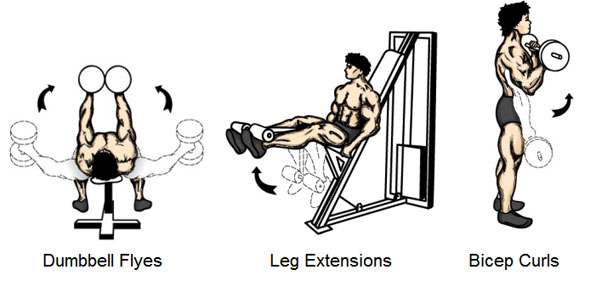
ISOLATION EXERCISES: Isolation exercises are movements that only work one joint and muscle group at a time. A good example of isolation exercises would be the Leg Extensions.
One of the ultimate benefits of performing isolation exercises is their power to work a specific muscle group very effectively without exerting too much energy. Certain muscle groups can not be isolated effectively due to the poor bio-mechanics of compound exercises. In most cases, there are several weak areas of your body that could be left out without being noticed during a compound exercise whereas an isolation exercise would allow you to realize your strengths and weaknesses as you are performing that given exercise. This way you can target a weak body part and specifically isolate that body part in order to improve.
Also, Isolation exercises are also commonly used while recovering from an injury. Since you are able to isolate specific areas without putting stress on multiple joints, it is more favorable of an option as opposed to a compound movement.
EXAMPLES OF ISOLATION EXERCISES:
Shoulders: Front Raise, Side Raise, Reverse Fly
Biceps: Concentration curls, preacher curls, Spider curls
Triceps: Cable Press downs, Triceps kickback, Single arm overhead extensions
Legs: Leg extensions, leg curls
Back: Straight arm pull downs, barbell pull overs
Chest:Cable Crossovers, dumbbell fly
Biceps: Concentration curls, preacher curls, Spider curls
Triceps: Cable Press downs, Triceps kickback, Single arm overhead extensions
Legs: Leg extensions, leg curls
Back: Straight arm pull downs, barbell pull overs
Chest:Cable Crossovers, dumbbell fly

COMPOUND EXERCISES:
Compound Exercises are multi-joint movements that work several muscle groups all at once. A perfect example of a compound exercise would be the Barbell Squat.
One of the biggest reasons why compound exercises can not be avoided is their ability to release anabolic hormones naturally. Hormones such as testosterone, insulin-like growth factor 1, and growth hormone are released after the nervous system goes under stress through compound exercises. In return, these hormones aid recovery which will lead to muscle growth and help with overall mass gains.
Time is another positive factor when it comes to compound exercises. Since multiple muscles are all working at once, this is a great choice for individuals who are short in time to get a great full body workout.
As far as the weaknesses goes, the compound movements are not mechanically engineered to isolate weak areas specifically form different angles. Also compound movements are not the best option to train with if you are suffering from an injury such as an ankle sprain. For example, you could still train your legs with isolation exercises such as leg extensions and leg curls without having to put any weight on your ankle joint.
EXAMPLES OF COMPOUND EXERCISES:
Shoulders: Military Press, Arnold Press, Hang Clean and Press
Biceps: Close-Grip Chin-Up (with palms facing toward your face), Standing Barbell Curl
Triceps: Close-Grip Pushup, Dips, Close Grip Bench Press
Legs: Stiff Legged Deadlift, Barbell Squat, Lunges
Back: Deadlifts, T -Bar rows
Chest: Barbell Bench Press, Dumbbell Bench Press
Biceps: Close-Grip Chin-Up (with palms facing toward your face), Standing Barbell Curl
Triceps: Close-Grip Pushup, Dips, Close Grip Bench Press
Legs: Stiff Legged Deadlift, Barbell Squat, Lunges
Back: Deadlifts, T -Bar rows
Chest: Barbell Bench Press, Dumbbell Bench Press

THE BEST OF BOTH WORLDS:
We talked about a few different pros and cons of both the isolation and the compound movements. But the ultimate and most beneficial workouts are achieved through a combination of both these movements.
A great strategy while combining these 2 movements would be to start with a compound exercise that works several different muscle groups including a lagging area. For example, if a trainee wanted to bring up his/her hamstring muscles, it would be a great option to begin with a compound exercise such as the Stiff legged Deadlift and finish out the workout with an isolation move such as the lying leg curl.
In this article, I will keep it quite simple and give you 2 options to pick from.
OPTION 1: TRADITIONAL METHOD
COMPOUND EXERCISES first:
ISOLATION EXERCISES as finishers:
ISOLATION EXERCISES as finishers:
EXAMPLE QUADRICEPS WORKOUT:
Warm up: Of choice
BARBELL SQUATS: 3 sets of 10 repetitions
DUMBBELL SQUATS: 3 sets of 10 repetitions
LEG EXTENSIONS: 3 sets of 15-20 repetitions
DUMBBELL SQUATS: 3 sets of 10 repetitions
LEG EXTENSIONS: 3 sets of 15-20 repetitions
OPTION 2: PRE-EXHAUSTING METHOD
This method consists of a workout program that begins with the isolation exercise to pre-exhaust the targeted muscle group and then go into a compound exercise to finish with.
Warm up: Of choice
3 sets of 15-20 Seated Leg Curls
3 sets of 15-20 Lying Leg Curls
3 sets of 10-12 Stiff Legged Deadlifts
3 sets of 15-20 Lying Leg Curls
3 sets of 10-12 Stiff Legged Deadlifts
CAUTION: If you pick this method, make sure to go much lighter than normal on the compound exercise due to the pre-fatigued muscles.
Next time you are in the gym, pick one of the above options and work on the weak areas. For those of you suffering from injuries, you can always get around certain injuries by picking the right isolation exercise and continue your training.