Showing posts with label Benefits of work outs. Show all posts

Thursday, May 16, 2013

Article # 489. How much strength training should I do?


Every adult, whether female or male, young and old, should perform some type of strength training at least twice a week. As a woman in her 40s, you are at an age where it can really make a difference in your health and your life – not only now, but also in the decades to come.

Just as aerobic exercise is crucial to your cardiovascular fitness, strength training is the key to muscle strength and balance. Here are just a few ways that regular strength training can benefit you as you head into your 50s and beyond:
·         It burns calories to help you keep your weight down
·         It increases bone density, which lowers your risk of osteoporosis and broken bones
·         It strengthens your muscles, which improves your balance and makes you less likely to fall and injure yourself
·         It reduces your chances of joint injuries
·         Through all of the above benefits, it increases your ability to take care of yourself, to get around and to live independently in your later years
In terms of the time investment, you’re on the right track by spending more time on aerobic activity – the more time you put into it, the more the benefits accrue. Strength training, on the other hand, doesn’t require as much time to achieve results – the benefits are related less to the time you spend and more to the quality of effort that you put into each action. (Quality of effort involves “overload,” “progression” and “specificity” – read more about this in my answer to a previous reader question.)

For general fitness, a good balance of cardio and strength training might include three to four days a week focusing on cardiovascular activity (20 to 40 minutes each session), and two days focusing on strength training (including exercises for all muscle groups). 

An advanced program might include four to six days of cardiovascular training (focusing on intensity vs. time on alternating days) and four days of strength training using a split routine (focusing on different muscles groups on alternating days).

One way to structure a balanced and beneficial program is to follow the FITT principle:
Cardiovascular exercise for Fitness:
·         Frequency: 3 to 5 times per week
·         Intensity: moderate to moderately difficult activity
·         Time: 20 to 40 minutes per session
·         Type: any type of rhythmic, large-muscle-group activity that gets your heart beating faster, such as walking, jogging, jumping rope, swimming or dancing
Strength training for Fitness:
·         Frequency: 2 to 3 times per week
·         Intensity: load or weight = 60 to 75% of the maximum amount you can lift one time for that exercise
·         Time: 1 to 3 sets (8 to 15 reps per set) each of 6 to 10 exercises involving all of the major muscle group areas: chest, back, shoulders, arms, low back, abdominals, hips/thighs and calves
·         Type: any type of resistance exercise that works the major muscle groups, such as weight machines, free weights, exercises using tubing, or exercises using your own body weight for resistance, such as curl ups, pull ups, push ups and squats
In addition to cardiovascular and strength training, a complete exercise program also should include some flexibility and range of motion exercises. Once you’ve incorporated all three of these fitness essentials into your life, you should be in great shape. Keep up the good work!


Friday, March 1, 2013

Article # 350. Basic At-Home Workout


Level of Difficulty:

3.5 out of 5 rings

Equipment:
One pair of 5- or 8-lb dumbbells and a 10-lb kettlebell (optional)

Time Commitment:
25 Minutes
Time / Repetitions
Exercise
5 Minute Cardio Warm-up
25 Jumping Jacks
20 seconds Jogging
20 seconds Skipping Rope
20 seconds Butt Kicks (running)

Repeat one more time!
Quick Cardio Interval
8 seconds Runs in Squatted Football Stance
20 seconds Jogging

Repeat five times through
Women's Health Resistance Routine (see photos)

15 repetitions each exercise
Goblet Squat (using 10-lb kettlebell or dumbbell)
Hammer Curl to Press (8-lb dumbbells)
Dumbbell Deadlift (8-lb dumbbells)
Kettlebell Pullover (10-lb kettlebell or dumbbell)
Single-Arm Kettlebell Row and Twist (10-lb kettlebell or dumbbell)
Quick Cardio Interval
25 Jumping Jacks
50 Crunches (your way)
25 Monster Tires
10 Heisman Jumps
Women's Health Resistance Routine (see photos)

15 repetitions each exercise
Goblet Squat (using 10-lb kettlebell or dumbbell)
Hammer Curl to Press (8-lb dumbbells)
Dumbbell Deadlift (8-lb dumbbells)
Kettlebell Pullover (10-lb kettlebell or dumbbell)
Single-Arm Kettlebell Row and Twist (10-lb kettlebell or dumbbell)
Ab Work / Cool Down
50 Crunches (your way)


Article # 349. Top 10 muscle exercises you can do at home


If you detest to visit the fitness center, you are not alone. The good news is – you will get leads to the comfort and ease of your personal house with some easy home workouts.
Bodyweight coaching Can be efficient. It can be considered a substitute for weights, if essential. Training utilizing your own body excess weight as being a supply of resistance is a time examined technique to obtain outcomes quick.
Right here are the 10 best bodyweight coaching workouts that provide you with great workouts and fantastic outcomes – with out the fitness center.
1. Supine Pull-Ups (operates major muscles in back, shoulders, and biceps)
Use two chairs along with a pole – a hefty broom deal with operates nicely. WARNING: make certain the chairs are stable and that the broom deal with is strong enough to take your excess weight. You could be SEVERELY injured if the pole had been to interrupt or even the chairs to slip. Lie on your back beneath a low bar. Grab the bar having a wide overhand grip. Pull up. Decrease and repeat for 6-8 reps.
2. Supine Biceps Pull-Ups (biceps, some back again)
Utilize the same chairs-and-pole arrangement from #1. Sit underneath a reduced bar. Grab the bar having a reverse grip (palms facing you), fingers about shoulder-width apart. Keeping the body upright, pull up till your chin just clears the bar. Focus on the tension inside your biceps, trying to relax the remainder of one’s physique. 6-8 reps.
3. Push-Ups (chest, triceps, shoulders)
The important thing when focusing on the chest with Push-Ups is the direction in which your elbows travel. As with bench presses, the elbows should transfer Far from THE Physique to focus on your chest, and be stored Shut Towards the Body to target the triceps. Location each hand just outdoors your shoulders, somewhat behind the line of your shoulders. Hands pointing straight forward, higher physique rigid as being a board. 6-15 reps.
4. Tent Push-Ups (primarily upper chest)
Presume the place in #3, but stroll your feet forward so your body is bent at the waist, and your hips are up high within the air. Bending at the elbows, decrease your self till your nose touches the floor. Push up. Repeat. 6-8 reps.
5. Push-Ups, Triceps Place (you guessed it – triceps, and a few chest)
Start with fingers dealing with forward in position from #3, hands somewhat Less than shoulder width apart. Decrease your body to the floor keeping arms in in opposition to the body. Push up. 6-8 reps.
6. Triceps Dips
With Chairs Together with your hands behind your back, assistance yourself on your palms at the edge of a chair. Your fingers ought to be touching; your elbows ought to angle outward. Dipping within this position relieves a lot of stress around the elbow and shoulder joints. Lower yourself, retaining your back close towards the chair. Bend your elbows back again and slightly towards the sides. Maintain the body angled somewhat ahead all through the movement. Press your self up until your arms are straight. 6-15 reps.
7. One-Legged Squats (front thighs, glutes, hamstrings)
Stand perpendicular to a wall, about arm’s duration far from it. Extend your arm out towards the side and location your palm in opposition to the wall at just beneath shoulder-height. Angle the foot farthest through the wall at 45 degrees. Bend the other leg back again. Retaining your body upright, decrease yourself till the non-weight-bearing knee is close to (but not touching) the floor. Support your self by leaning in opposition to the wall. Press yourself back again as much as beginning place. Repeat 6-8 reps.
8. One-Legged Hamstring Bridges
Lie on your back again with one leg extended, heel on the floor. Maintain the other leg up off the floor. Pushing through your heel, flex your hamstrings to lift your body. Lower and repeat for 8-10 reps. Repeat with other leg. You are able to control the resistance and the degree to which the glutes lead by altering the distance you location your heel relative for your butt.
9. Lunges
Start the lunge by taking a large stage forward, keeping your head up and torso erect. Decrease your hips and permit your trailing knee to drop to a stage just before it touches the floor – never allow the knee touch the floor. To return towards the begin, push off with your ahead leg after which stage back once the knee is completely straight. Repeat with other leg, 10-15 reps every leg.
10. Stair Running
Stair operating isn’t generally regarded as a resistance physical exercise, and in fact, it tends to make hefty demands in your cardiovascular system. However, it also does an extraordinary job of conditioning the lower physique. In case your knees are in good shape, try performing 10-20 one-story sprints, preferably two stairs at a time. As you get more powerful, work up the number slowly, keep 1 hand around the stair rail to catch your self in the event you lose your stability.

Article # 347. Home Workout Program For Beginners – Best Fat Burning Exercises


Home Workout Program For Beginners – Best Fat Burning Exercises

Newly embarking on a home workout program can be exciting and confusing.
Knowing which fat burning exercises to include in your workout to achieve your goals can make or break your success.
Workout safety is also always a concern for beginners.
  • Did you check with your physician?
  • Do you have enough space free of anything you can trip on?
  • Are you starting slowly enough so that you don’t over do it on the first workout?
  • Do you know which fat burning exercises you should perform and how to do them properly?
Here is a list of the best fat burning exercises you can do in a home workout program for beginners:
Always perform Warm up and Stretching before and after excercises.
  1. Bodyweight Squats – Stand with your feet slightly wider than shoulder width apart and your arms at your sides. Brace your core, keep your back flat, and bend your knees to lower yourself to the floor while simultaneously bringing your arms straight out in front of you until parallel to the floor. Lower yourself until your thighs are parallel to the floor then push yourself back up, lowering your arms and standing up straight.
  2. Push ups on your knees -get down on the floor facing down with all of your weight distributed between your knees and your hands. Arms should be fully extended with hands directly below your shoulders slightly wider than shoulder width apart. Use your core to hold your body in a straight line between your head and your knees. Lower your chest to the floor by bending your elbows. Lower yourself until your chest is about 1-2 inches off the floor. Return to starting position by pushing your body back up until arms are again fully extended.
  3. Laying hip extensions – Lay on the ground with your knees bent to about a 90 degree angle and feet flat on the ground. Brace your core and lift your hips up in the air so that there is a straight line between your shoulders and your knees. No sagging hips! Return to near starting position but do not let your hips hit the ground in between repetitions.
  4. One arm dumbbell rows -Place your left knee and and hand with extended arm onto a bench. Your right arm should be straight down holding the dumbbell or kettlebell. Brace your core, squeeze your back muscles and lift the weight straight up until at chest level. Slowly lower back to original position.
  5. Elbow plank – get down on the floor facing down with all of your weight distributed between your toes and your elbows. Position your arms so that they are bent at a 90 degree angle and your elbows are directly below your shoulder. Use your core to hold your body in a straight line, perpendicular to the floor. Do not cheat and put your hips up in the air! Straight line!
  6. Jumping jacks – Begin in a standing position with your arms at your sides and feet shoulder width apart. Jump up and bring your arms out and up overhead and your legs out wide. Jump up again and return to standing position.
To get in a highly effective and super quick workout program right at home, just complete these fat burning bodyweight exercises in the order above with no rest in between each one. After you complete the jumping jacks. Rest for one minute and then repeat the circuit 1-2x.
And there you have it! A great beginner home workout program that you can do at home anytime with no equipment that will really burn fat.

Thursday, February 28, 2013

Article # 346. Beginner Workout Schedule


Beginner Workout Schedule
A beginner workout schedule should be a light one with a minimal possibility of injuries and a well-balanced workout that focuses on all the major muscle sets. Keep reading to know about the details of the workout schedule for beginners.
A beginner can start a workout, without buying any expensive fitness equipment. However, if you wish to hire an instructor then it is best to join a gym, where you will be provided with a fitness instructor. But if you wish to form a workout routine yourself, then you need to include the 5 components of physical fitness which are cardiovascular endurance, muscular strength, muscular endurance, flexibility and body composition. Here are the guidelines for a beginner workout schedule with a sample chart for you to follow.


Guidelines for Workout Schedule for Beginners

When starting a workout, it is important that you monitor your body mass and use exercises which best suit your body composition. Here are some important guidelines you need to follow when starting on an exercise routine for beginners.

Measuring Your Body

Before starting a beginner workout routine, it is important that you design the workout schedule according to your needs. For example, the workout can be aimed at weight loss, muscle gain, or simply for fitness. The first thing you need to do is to weigh yourself, and using a measuring tape, measure in inches, your different body parts like hips, butts, chest, thighs, calves, shoulders, biceps, triceps etc. Note down these measurements in a diary or enter it in a excel sheet in your personal computer.

Cardio Workout/Full body Workout

If you wish to opt for weight loss, then focus on cardiovascular exercises which burn maximum amount of calories. Some of the best options are skipping, running and cross-training on an elliptical machine. For muscle gain, opt for boxing workouts (to build muscles fast), swimming (to build lean muscles) or simply jogging and running. If you wish to enter a beginner workout plan to be in good shape, then opt for simply jogging and running. It is very important that you perform a warm-up session of 10 minutes, before starting on cardio. A warm-up can also be mild jogging.

Muscle Training

For muscle training, the best exercises are weight training and floor exercises. However, people aiming at weight loss, who have fat mass in specific body parts, need to concentrate on that part particularly. People who want to gain muscles need to follow weight training exercises for all the muscle sets equally. People looking to just tone-up their body, should stick to light weight exercises. Some examples of muscle training exercises are calf raises, leg extensions, back extensions, etc.

Stretching for Flexibility

Another important aspect of a beginner workout plan is to perform stretching after a workout. Stretching helps to improve flexibility and is necessary to establish the full range-of-motion for your body joints. These range-of-motion exercises are especially advised for people who have undergone a surgery. While stretching, focus on relaxing and breathing slowly.

Improvising Your Workout

Keep checking your weight on the first date of every month, and again measure your body parts, to check if you have lost weight in inches or gained muscle mass. After a month, you can add a bit more of weight to your exercises and some more repetitions of weight training exercise.
After two months, you can include some advanced weight training exercises. If you are not reducing weight or slowly reducing weight from a specific body area, then consider adding more weight to your workout. For weight loss, make sure you burn more calories than you consume on a daily basis.
For muscle building, eat more protein rich foods as they are the building blocks of our body and help develop muscles. People who want to maintain their shape should follow a balanced diet. Here is a sample chart which you can follow to start a beginner workout program.


WeekMondayTuesdayWednesdayThursdayFridaySaturdaySunday
1st WeekA cardio session of 45 minutes½ an hour of cardio followed by 15 minutes of shoulder exercisesA cardio session of 45 minutes½ an hour of cardio followed by 15 minutes of chest exercisesA cardio session of 45 minutes½ an hour of cardio followed by 15 minutes of Biceps exercises or can even Rest this dayRest
2nd Week½ an hour of cardio followed by 15 minutes of abdominal exercises½ an hour of cardio followed by 15 minutes of lower body exercises
3rd Week½ an hour of cardio followed by 15 minutes of triceps and biceps exercises½ an hour of cardio followed by 15 minutes of back exercises

Friday, February 22, 2013

Article # 317. 10 Strength Building Strategies


10 Strength Building Strategies


Follow these 10 rules for immediate and long-lasting muscle and strength.


Strength is the foundation of nearly all physique and performance goals. When you're strong, you more easily gain muscle size, lose fat, run faster, hit harder, play longer, and move more living room furniture for your wife. We've rounded up 10 no-questions-asked tips to help you make everything in your life feel just a little bit lighter.
1. Own the "big four."
The squat, deadlift, bench press, and shoulder press are the best strength-building exercises, period. The chinup and row are great moves too, but don't make them the focus of your workout — they can be assistance lifts to complement the bench and shoulder press, keeping your pulling muscles in balance with the pressing ones.
2. Use barbells first.
Forget all the fad equipment. The barbell is king, the dumbbell is queen, and everything else is a court jester — it may have its place, but it's not essential. Start your workouts with barbell exercises, such as the "big four," as described above. Barbells let you load a lot of weight, and lifting heavy is the first step toward getting stronger. Once your heaviest strength exercises are out of the way, you can move on to dumbbell and body-weight training.
3. Keep it simple.
Some trainers make their clients lift with a certain rep speed, like three seconds up, one second down. But know this: There's no need to count anything but reps during a set. Simply focus on raising and lowering your weights in a controlled manner, pausing for a one-second count at the top of the lift. Using an arbitrary tempo can lessen tension on your muscles or force you to use varying amounts of weight, slowing your progress. The only way to be sure you're getting stronger is if your loads consistently increase.
4. Maintain a log.
Write down your exercises, sets, reps, and the fate of each workout. Keep track of your best lifts and the most reps you've done with a certain weight on an exercise. Constantly strive to improve those numbers.
5. Don't overdo it.
Try to stick to three or four lifts per workout. Keeping your workouts short helps you take advantage of hormonal surges. When you do too many exercises in a session, at least some of them get done half-assed. All you need is one main lift per workout (one of the big four), one or two assistance lifts (for keeping the body in balance and further strengthening the muscles that perform the main lift), and then core or specialty work at the end (ab exercises or some forearm or calf moves, depending on your goals). Doing any more lessens your results.
6. Think five.
You should rotate many different rep ranges in your workouts, but sets of five seem to offer the best blend of muscle size and strength gains. If you're pushing through one of the big four moves, you'll find that your form often breaks down after five anyway.
7. Add weights slowly.
The main reason people plateau and stop gaining strength is that they go too heavy for too long. Abandon your ego and do your main lifts using 10% less than the most weight you can lift for the given rep range. Increase the weight each session — but by no more than 10 pounds — and stick with the same lifts. You'll rarely plateau again.
8. Take to the hills.
Cardio is a must if you want to be lean and healthy, but long-distance running or cycling increases levels of hormones that break down muscle tissue. To get stronger while getting leaner, do cardio in short, intense bursts. Go to a moderately steep hill and sprint to the top, then walk back down. When you're ready, sprint again. In your first workout, do only half as many sprints as you think you could. In your next workout, do two more sprints than you did the first time. Continue adding two sprints to your workouts until you can't improve anymore. Then do sets of sprints.
9. Balance your training.
Whatever you do for one side of the body, you must do for the other side. Follow that rule in your workouts and you should be able to avoid injury and muscle imbalances. If you're doing squats (mainly a quad exercise), also do Romanian deadlifts (which hit the hamstrings hard). Your chest exercises should be balanced with back-training lifts. You don't necessarily have to do your balance work in the same session, but it should be done in the same week. In general, follow a ratio of two-to-one between your pulling-and-pushing movements. So if you bench-press on Monday (and most of the world seems to), you can do chinups on Tuesday and bent-over lateral raises on Thursday, for example. Every other pressing exercise you do should follow this formula.
10. Do it right. Form is key.
You may think you know how to perform the big four, but you could probably get more out of them. Here are some quick pointers for each one.

·         Squat: Begin the squat by pushing your hips back as far as you can. Keep your lower back arched and you should feel a stretch in your hamstrings. When your hips are bent, begin bending your knees and squatting low. This is what you need to squat maximal weight.
·         Deadlift: Use the same stance you would to perform a jump — your legs should be narrowly placed. When you bend down to grab the bar, keep your hips down and your back straight, with your shoulders directly over your knees.
·         Bench Press: Start with your head off the bench. Keeping your feet steady, grab the bar and pull your body up off the bench and forward, so that when your butt comes down on the bench your lower back is very arched. Squeeze your shoulder blades together. Your range of motion should be significantly shorter for stronger pressing.
·         Shoulder press: Flare your lats when the bar is at shoulder level. It will allow you to use more weight.

Tuesday, February 19, 2013

Artilce # 315. 20 Minutes Circuit Workout


Lose Fat, Build Muscles With Circuit Training

Circuit training is one of the best ways to make a resistance and strength training workout that is also challenging for your heart and lungs.
This workout is a 20-minute workout that will take you to your maximum physical effort as well as your maximum heart rate. The object of this workout is not to rest in between exercises. You will see that one minute of a particular exercise will burn out the targeted muscle group as well as increase your heart rate to a fat and sugar burning zone. Try the 20 minute workout below - if it is not challenging enough for you try it again, totaling only 40 minutes of your time in the weight room.

20 Minutes Circuit Workout

(*choose light weights for max reps)
1) Bench press* or pushups - max in 1:00
2) Squats - max in 1:00
3) Pullups or pulldowns - 1:00
4) Bike or jog - 3:00
5) Military press* - 1:00
6) Lunges - 1:00 each leg
7) Bicep curls - 1:00
8) Bike or jog - 3:00
9) Tricep extensions.- 1:00
10) Leg ext - 1:00 (requires leg machines - or repeat squats with weights)
11) Leg curls - 1:00 (requires leg machines - or repeat lunges with weights)
12) Situps - 2:00
13) Crunches - 2:00
14) Stretch

There is an unlimited number of ways to organize a circuit workout. The above workout is organized with upper body, lower body and cardiovascular exercises. By simply doing the above upper body and lower body exercises in such a way, you will be able to rest your upper body muscles while you workout your lower body muscles, but you will never rest your heart.

This is how you make the circuit workout challenging to your cardiovascular system as well as your major muscle groups. Studies have shown that mixing a resistance training regimen with a cardiovascular element will increase your metabolism, therefore burning fat and building muscle. The result is a decrease in body fat percentage.

So, if you are looking to lose inches and body fat, workouts like this coupled with 4-5 smaller meals and 3-4 quarts of water everyday will help you achieve your goal. The best thing about this diet program is that you do not need a single dietary supplement - just good old fruits, vegetables, whole grains, fish and other lean meats. The key is to burn more calories than you take in and this workout will help you with that - promise.

Artilce # 314. What Is Circuit Training?


What Is Circuit Training?
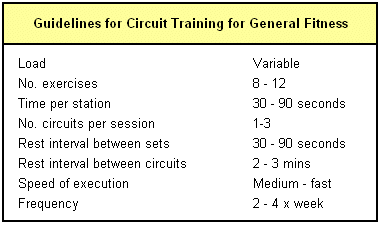
Circuit training is short bursts of resistance exercise using moderate weights and frequent repetitions, followed quickly by another burst of exercise targeting a different muscle group.
Because the exerciser switches between muscle groups, no rest is needed between exercises. This gets the heart rate up, which usually doesn't happen during resistance exercise. Sometimes, to up heart rate further, aerobics are sprinkled between the resistance exercises.
They are set to give more resistance the faster you go, so you don't have to adjust that. There are 15 machines. So you go on one machine for 30 seconds, and then jog on a pad for 30 seconds. Then you go on the next machine, and then jog. Once around [the machines] -- 15 minutes. We go twice around. Then you're done!
A recording signals when to change machines or jog. Every 10 minutes, the exercisers check their heart rate.
"Ideally," says Wayne L. Westcott, PhD, fitness research director at the South Shore YMCA, in Quincy, Mass., "you get to 40% to 60% of maximum heart rate."


Is Circuit Training Enough?
According to Westcott, a circuit workout improves both strength and endurance, and jump-starts metabolism.
"When those women leave the gym, they are still burning a third more calories than they did in the workout -- and this goes on for hours!" he says. "Once you build muscle, muscle burns more calories [than fat], so you continue to burn more."
Although weight training has traditionally been a male pastime (think Ah-nold), it's important for women, who tend to lose muscle mass at the rate of 1% per year in their late 30s and 40s. This muscle often gets replaced by fat. But you need muscles to cushion joints and help protect against osteoporosis, among other benefits. That's not to mention the trimmer, tighter appearance you'll gain by toning up.
Circuit training works because it's short and sweet and people actually do it. (Many gyms, as well as a chain called Health Inspirations, offer circuit training to both sexes.) "It's brief, it's basic, it's consistent; no frills, over quickly" is how Westcott puts it.


Circuit Training at Home
If driving to the gym (much less working out in front of God and everybody) is a deterrent, Westcott recommends setting up a modified circuit at home. This way, you can also tailor your circuit to your fitness level. Beginners, for example, might use 5-pound weights and move up as their strength improves.

Your home circuit could go like this:
·         30 seconds of squats
·         30 seconds on a stationary bike, or jogging in place or on a treadmill 
·         30 seconds of lunges (watch those knees!)
·         30 seconds of cycling or jogging
·         30 seconds of chest presses on a weight bench or sturdy table
·         30 seconds of cycling or jogging
·         30 seconds of bent-over rows on a weight bench or sturdy table
·         30 seconds of cycling or jogging
·         30 seconds of shoulder presses (push your arms straight overhead with palms facing out
·         30 seconds of cycling or jogging
·         30 seconds of biceps curls
·         30 seconds of cycling or jogging
Repeat the whole cycle at least three times.
And you don't even need to invest in weights, at least not at first. Bryant says you can fill gallon milk jugs with sand or water to make a weight.
The important thing, Bryant says, is to make an effort. "Exercise is cumulative. Each time you do it, the benefits add to the last," he says. "I say it's like loose change. It adds up."
And to make sure you keep at it, choose an activity that fits into your schedule -- and that you enjoy.